- …


- …
- …
- …
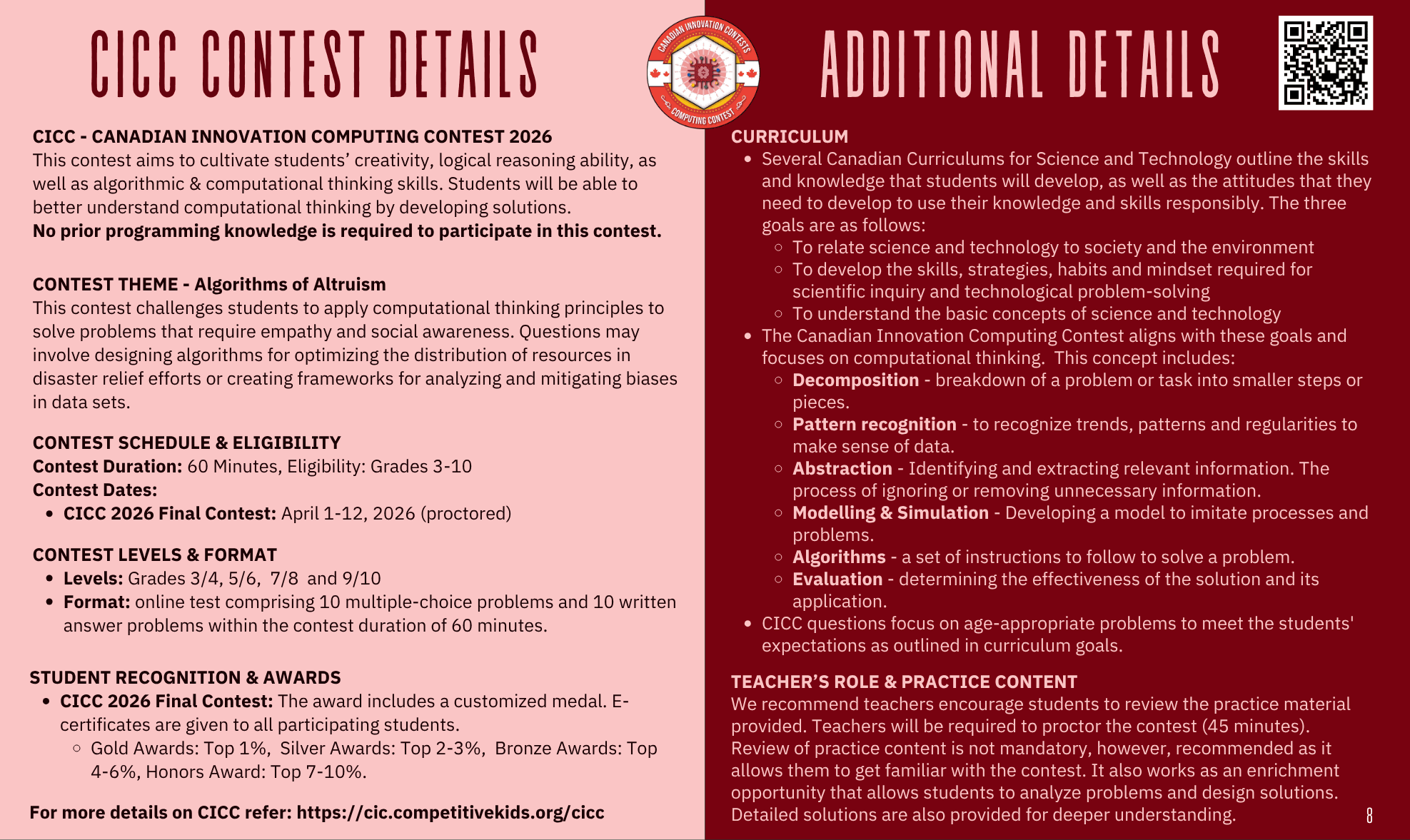
CICC 2026 Theme
CICC 2026 Contest FAQ
WHAT IS THE CANADIAN INNOVATION COMPUTING CONTEST (CICC)?
The Canadian Innovation Computing Contest, popularly known as CICC, is an initiative by Competitive Kids STEM. This contest aims to cultivate students’ creativity, logical reasoning ability, and algorithmic & computational thinking skills. Students will be able to better understand computational thinking by developing solutions. It involves defining problems, analyzing problems and designing their solutions. Prior programming knowledge is optional to participate in this contest.
Canadian Computing Innovation Contest (CICC) is carefully designed for teachers to provide an excellent enrichment opportunity to their students.
CURRICULUM CONNECTION
Several Canadian Curriculums for Science and Technology outline the skills and knowledge that students will develop, as well as the attitudes that they need to develop to use their knowledge and skills responsibly. The three goals are as follows:
- To relate science and technology to society and the environment
- To develop the skills, strategies, and habits of mind required for scientific inquiry and technological problem-solving
- To understand the basic concepts of science and technology
The Canadian Innovation Computing Contest aligns with these goals and focuses on computational thinking. This concept includes:
- Decomposition - breakdown of a problem or task into smaller steps or pieces.
- Pattern recognition - to recognize trends, patterns and regularities to make sense of data.
- Abstraction - Identifying and extracting relevant information. The process of ignoring or removing unnecessary information.
- Modelling & Simulation - Developing a model to imitate processes and problems.
- Algorithms - a set of instructions to follow to solve a problem.
- Evaluation - determining the effectiveness of the solution and its application.
CICC questions focus on age-appropriate problems to meet the students' expectations as outlined in curriculum goals.
CONTEST ELIGIBILITY & FORMAT: APRIL 1-12, 2026
- Eligibility: Grades 3-10
- Contest Dates: April 1-12, 2026
- 4 Contest Levels - Grades 3/4, 5/6, 7/8, and 9/10
- Online Test Format: 10 multiple-choice problems and 10 written-answer problems within 60 minutes related to the skills required for computational thinking.
- Logistics: The contest will be held online.
- Practice Content: Optional practice content is available to all students for free. Though not mandatory, it offers additional enrichment opportunities to the students. The focus is on solving questions that allow students to analyze problems & design solutions.
- Practice tests are available for students to attempt similar problems.
- Detailed solutions are provided as well for a deeper understanding.
STUDENT AWARDS
All contest participants are eligible for the following awards:
- Gold Awards: Top 1% of students for each contest level. The award includes a customized medal & e-certificate.
- Silver Awards: Top 2-3% of students for each contest level. The award includes a customized medal & e-certificate.
- Bronze Awards: Top 4-6% of students for each contest level. The award includes a customized medal & e-certificate.
- Honors Award: Top 7-10% of students for each contest level. The award includes a customized medal & e-certificate.
- Certificate of participation: Given to all participants.
* Because of the resources, CKSTEM will not pay for the international shipping to the schools. Awards will be sent to Canadian students, including schools and all other paid students. Students will also have an opportunity to join us in an award ceremony in the Greater Toronto Area (GTA).
PROCTORING
School Registrations: School teachers are responsible for proctoring students in school. Contest for a school grade must be proctored at the same time. If students take the contest at different times, only the first set of students will be considered for the awards. Up to 15 minutes of variation in start time is acceptable.
Individual Registrations: CKSTEM will proctor students who enroll for the contests directly with CKSTEM. Students are expected to use two devices with working cameras. Students must take the contest on a laptop and share the camera from this device on Zoom. The Second device is required to show the room from a different angle on Zoom. Honesty is the best policy. CKSTEM will provide multiple slots for the students to choose from during the contest period.
REGISTRATION PROCESS
- If you are a school staff interested in participating, you can find the registration package here. You may also contact us at info@ckstem.org. All contests are free for school registrations. We need a minimum of 5 students for school registrations.
- If you are an individual participant, you can enroll here. You must first create an account if you don't have it at our contest portal already. You can find instructions on how to create your account at https://www.competitivekids.org/blog/registration. There is a fee of 20 CAD for individual students.
CONTEST BROCHURE
You can download the Canadian Innovation Contests (CIC) brochure from here.
CICC 2024 PRACTICE QUESTIONS
You can download the CICC 2024 questions here. You will be able to find solutions after enrolling in the contest.
HELP US TO HELP OTHERS
SPREAD AWARENESS AND DONATE

We want to help students all across the globe. Please help us spread the word. We are confident that the participants will have fun solving some of the coolest problems with our unique approach, allowing them to try each problem more than once.
We also need funds to run this program, especially for licensing costs involving specific tools. The anticipated cost to facilitate this is over $15000. We are relying on the generosity of our donors to help meet this cost, as we will not be charging the students any contest fees. Therefore, we will greatly appreciate your support and donation.
CIMC ADVISORS

Ansh Agarwal
CICC Student Advisor
Ansh Agarwal is a grade 12 student who excels in math problem solving. Ansh was a bronze medalist in the Canadian Math Olympiad (CMO) and the Asian Pacific Math Olympiad (APMO) in 2025. He is also actively engaged in teaching with CKSTEM and AwesomeMath.
As a member of the CICC Advisory Committee, Ansh has contributed significantly to designing the contest and creating problems over the last few years.